
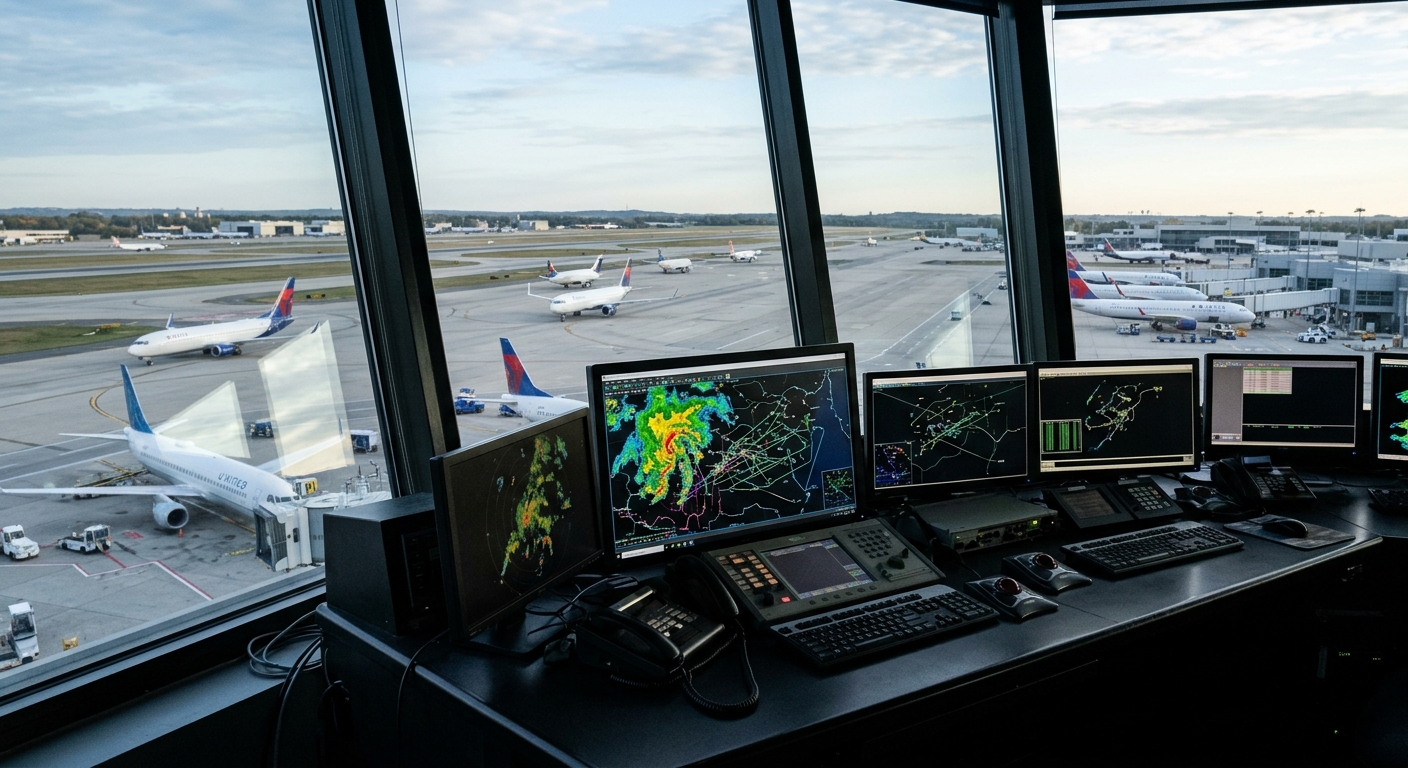
AI-generated illustration; not a photograph of the reported event.
- calendar_today November 16, 2026
FAA Responds to Ground Stop and SMART System Concerns
A recent nationwide airline ground stop has prompted scrutiny of the Federal Aviation Administration's (FAA) new SMART AI system. Government officials and Air Space Intelligence (ASI), the startup behind the SMART technology, have clarified that this incident was not caused by the $875 million AI-powered platform, which is being rolled out to help predict and manage problems in U.S. airspace.
Understanding the SMART AI System
The FAA's Strategic Management of Airspace, Routes and Trajectories (SMART) system is positioned at a facility near Washington. There, a team of experts analyzes flight schedules, weather forecasts, and hundreds of additional data streams. The system centralizes 200 data channels, including weather patterns, flight paths, traffic flow, and controller staffing levels, into a single platform. Recommendations are then relayed to the FAA’s command center and subsequently to air traffic controllers for consideration, but not execution by automation.
Timeline of the Rollout and the Ground Stop
The SMART system underwent initial testing in the Washington area this fall, during which the FAA reported benefits such as rerouting 180 flights, saving an average of 10 minutes and 80 gallons of fuel per flight, and in one case, reducing a Tampa-to-Dallas trip by 42 minutes. On November 10, SMART was expanded for national use across all 22 U.S. air traffic control centers—three days before the recent ground stop, which officials maintain was unrelated.
Official Statements Dispel Connection
Homeland Security Secretary Markwayne Mullin, along with top FAA and Transportation Department officials, publicly stated that there is no evidence linking the communications issues behind the ground stop to the SMART AI system. ASI, the technology provider, also denied any involvement of its products or FAA integrations in the incident.
Benefits and Capabilities of SMART
According to the FAA, SMART enables a comprehensive visualization of flights, illustrating traffic capacity, potential congestion, and weather disruptions, allowing specialists to solve issues before they arise. For instance, the system can quickly reroute flights to avoid storms and optimize use of available airspace. This process represents a shift from the FAA's traditional practice of closing large, rectangular segments of airspace during inclement weather, allowing for more precise and dynamic management.
Ongoing Concerns Over AI Integration
Despite assurances, lawmakers and advocacy groups remain cautious. In October, House Democrats called for a Government Accountability Office audit, citing limited input from aviation safety personnel and concerns about training and safety guardrails during deployment. The letter highlighted broader concerns about AI reliability, the risk of undermining human decision-making, and the phenomenon known as AI “hallucination”—fabricating false but convincing information.
Experts reiterated that SMART currently serves to inform—not replace—the judgment of trained air traffic controllers. "The AI does the math, the AI does the computation," said ASI co-founder and CEO Phillip Buckendorf, but humans remain ultimate decision-makers. Former top FAA official Mike O’Donnell emphasized the need for robust safeguards, stressing that technology must be verified and validated to ensure safety-critical information is accurate.
Addressing the Air Traffic Controller Shortage
The rollout of SMART coincides with a longstanding shortage of U.S. air traffic controllers, an issue highlighted for over a decade by the National Air Traffic Controllers Association. Experts agree that, while platforms like SMART can be valuable tools, they are not substitutes for extensively trained human controllers managing complex and high-stakes scenarios in the national airspace system.
International Context and Next Steps
Currently, no other country has a comparable AI-powered air traffic management system in operation, though similar technologies are being tested abroad. The FAA and ASI maintain that the SMART system represents a cutting-edge approach, designed to support—not supplant—the expertise of human air traffic controllers as the agency addresses evolving technological and staffing challenges.
Source: abcnews.com.