
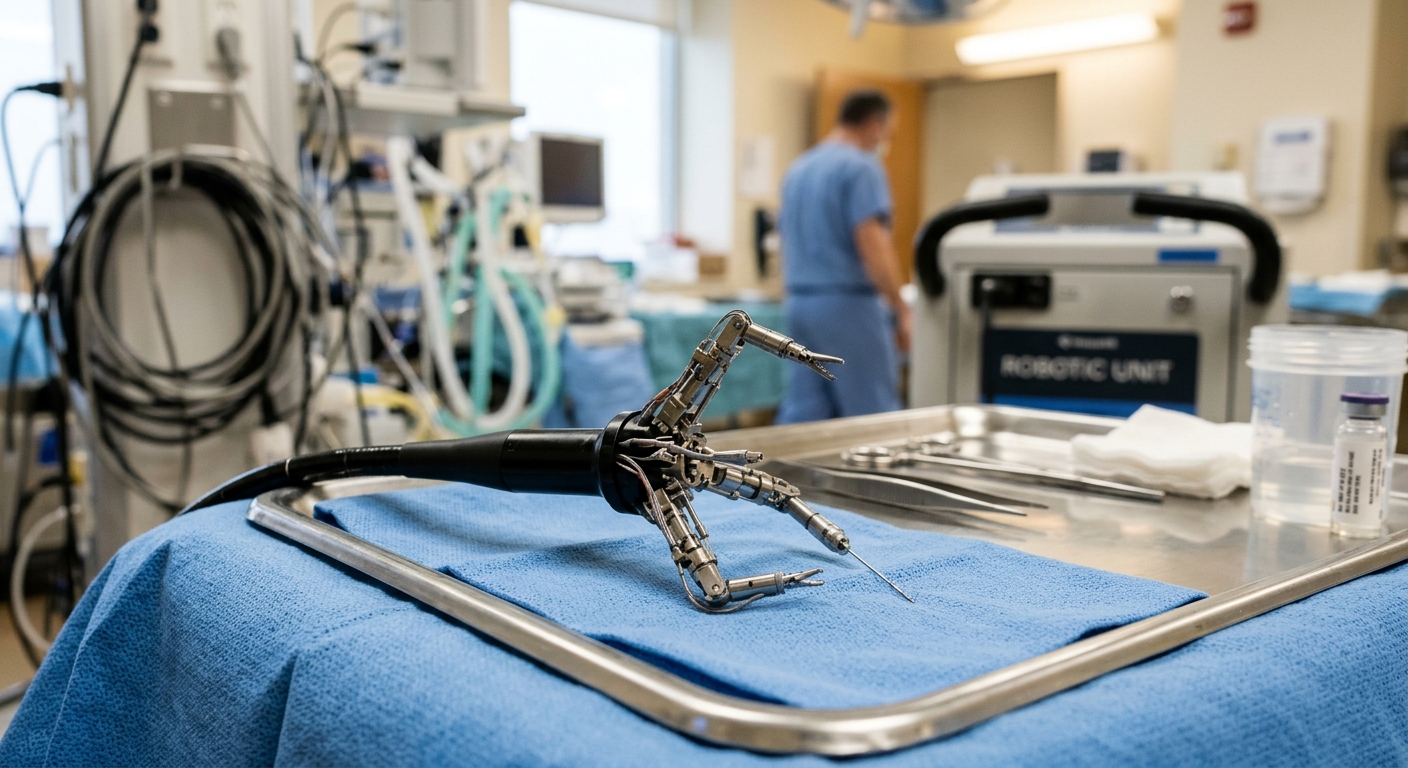
AI-generated illustration; not a photograph of the reported event.
- calendar_today November 22, 2026
Virtuoso Endoscopy System Receives FDA Clearance
The U.S. Food and Drug Administration (FDA) has granted De Novo authorization to the Virtuoso Endoscopy System, a new miniature surgical robot developed by Nashville-based Virtuoso Surgical. The device is designed to remove bladder tumors through the urethra without the need for external incisions, marking a significant advancement in minimally invasive surgery for bladder tumor removal.
How the Virtuoso Surgical Robot Works
The Virtuoso Endoscopy System features two needle-sized robotic arms made from a flexible alloy called nitinol, attached to the tip of a rigid endoscope. The system is controlled by a surgeon from a console, providing two-handed precision within the bladder's compact space. During the procedure, one arm lifts and stabilizes the tumor, while the other carefully separates it from surrounding tissues.
This technique enables surgeons to perform en bloc resection—removing the tumor in one piece—whereas traditional methods often fragment the tumor. The system is not autonomous; it relies entirely on the surgeon’s movements, unlike some experimental robotic systems that operate independently.
Potential Benefits for Bladder Cancer Diagnosis
Bladder cancer affects an estimated 84,530 people annually in the United States, according to the American Cancer Society. Obtaining an intact tissue sample, including portions of the bladder muscle, is critical for accurate cancer staging and can impact treatment decisions. Traditional transurethral resection of bladder tumor (TURBT) procedures often yield fragmented tissue, which can make diagnosis and assessment of the tumor’s invasion into the bladder muscle (detrusor muscle) more challenging for pathologists. By potentially improving access to more complete tissue samples, surgeons and pathologists may be able to more confidently determine whether cancer has spread into the muscle layer.
Dr. Duke Herrell, a urologic surgeon and CEO of Virtuoso Surgical, noted in the company’s FDA announcement that, “Removing a tumor intact can provide a better tissue specimen, which supports clearer diagnosis and staging.”
Early Clinical Results and Limitations
The Virtuoso Endoscopy System has undergone initial human testing. In the first 20 patients of the company-sponsored VIABLE study at The Chinese University of Hong Kong, 94% of removed lesions contained detrusor muscle — exceeding the study’s predefined goal of 60%. Additionally, surgical margins were evaluable in 93% of malignant lesions, an important factor in determining whether cancerous cells remain post-surgery.
No adverse events were reported in these 20 procedures. However, earlier phases of the study included six patients and recorded two postoperative complications: one case of temporary urinary retention and one patient who developed a chest infection later linked to an unrelated esophageal tumor.
Despite these encouraging findings, the research was conducted at a single medical center with a small number of patients, and the system has not yet been directly compared to conventional instrumentation in randomized clinical trials. More extensive studies are needed to confirm benefits such as improved outcomes or reduced need for repeat surgeries.
Details of FDA Authorization
The FDA’s De Novo authorization, issued on October 30, 2026, and publicly announced by Virtuoso Surgical on November 10, applies to the removal of bladder lesions and the collection of tissue samples in adult patients. The clearance establishes a new FDA category for robotic surgical instruments operating inside the body via endoscope. The authorization follows a Breakthrough Device Designation obtained in September 2025, which acknowledged the system’s potential and expedited its regulatory review.
The FDA noted that while the system is cleared for specific medical use, there is no evidence at this stage that it improves survival rates or prevents cancer recurrence. The technology must also be operated by trained surgeons in a clinical setting.
Next Steps and Future Applications
Virtuoso Surgical plans a limited launch in the United States beginning in 2027, focused on leading urology centers. Specific hospitals to receive the technology have yet to be announced. Broader availability will depend on factors such as price and insurance coverage.
While Virtuoso is exploring additional applications for its miniature robotic instruments, such as procedures involving the lungs, these remain experimental and are not FDA-authorized at this time. For now, the focus remains on bladder surgery and improving diagnostic accuracy through better tissue samples.
The Patient Perspective
Patients facing bladder cancer may eventually have a new surgical option for tissue removal and diagnosis. However, widespread access is not immediate, and further research is needed to confirm long-term benefits. Patients considering surgical intervention are encouraged to discuss the possibility of en bloc resection and tissue sampling strategies with their urologist.
Source: foxnews.com.