
- calendar_today August 20, 2025
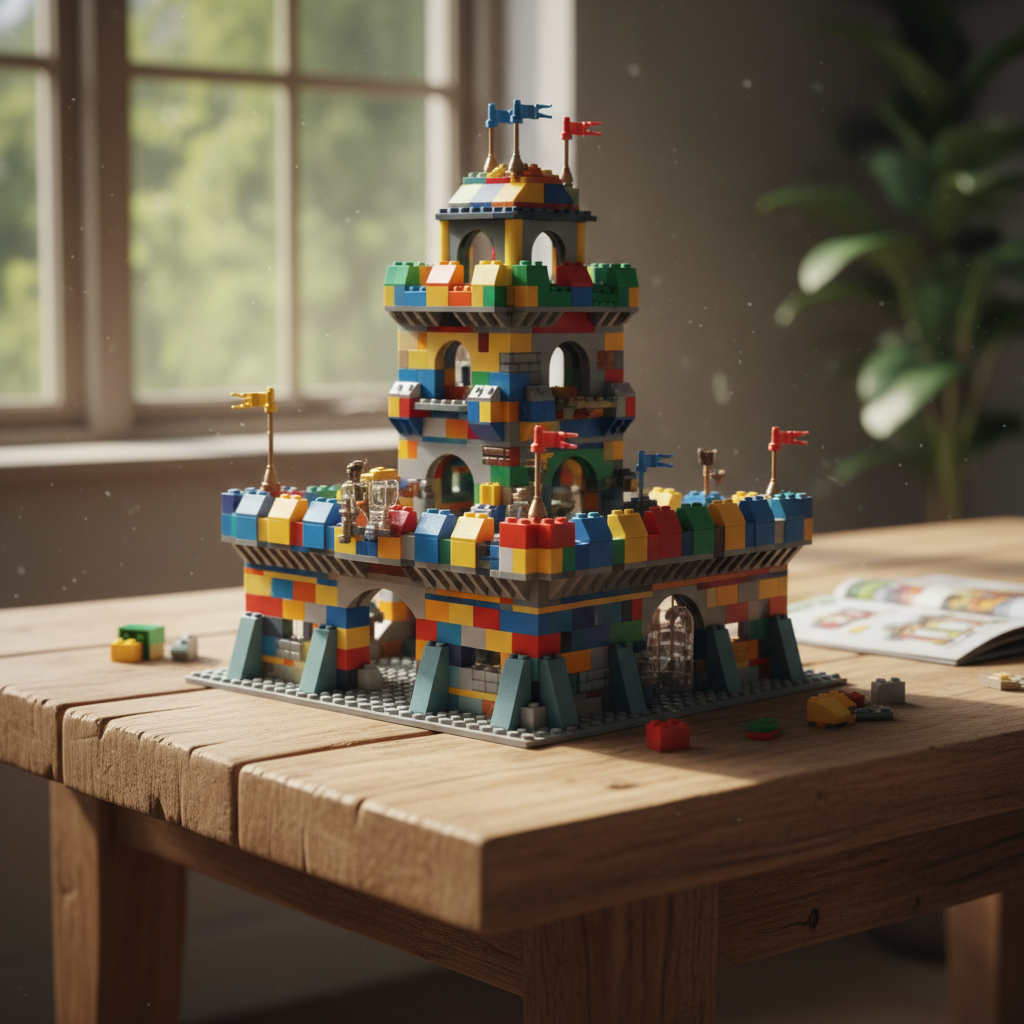
On Thursday, researchers at Carnegie Mellon University unveiled a groundbreaking innovation: LegoGPT represents a transformative artificial intelligence model that converts textual prompts into Lego formations that maintain structural stability. The new system creates Lego designs based on text instructions and makes sure these models are buildable in reality with human or robot assistance.
The researchers published their methodology in a paper titled “Generating Physically Stable and Buildable Lego Designs from Text” on arXiv. The researchers established a comprehensive LEGO design dataset that is physically stable and provided captions for each design before training an autoregressive large language model to predict sequential brick placement using next-token prediction methods.
The carefully trained model produces LEGO designs using different prompts, including “a streamlined elongated vessel” and “a classic-style car with a prominent front grille.” Although today’s designs remain simple with basic shapes formed from limited brick types, their main success comes from their physical stability.
Addressing the Limitations of Existing 3D Generation
The research team directed by Ava Pun pinpointed a major obstacle within the domain of 3D generation. Digital models can generate complex geometric structures but struggle during actual physical production. The researchers pointed out that improper support can lead to design elements collapsing under their weight or floating and becoming detached from each other.
LegoGPT sets itself apart from prior autonomous Lego modeling methods by producing instructions that ensure stable Lego constructions step-by-step. The project website features demonstrations that display the system’s outstanding performance.
How LegoGPT Works: From Language Model to Brick Placement
LegoGPT showcases its clever design by adapting technologies originally used in large language models to develop its brick placement system. LegoGPT uses “next-brick prediction” technology instead of “next-word prediction.” The Carnegie Mellon team refined the instruction-following language model LLaMA-3.2-1B-Instruct created by Meta to achieve their goal.
The team enhanced the brick-predicting model with an additional software tool that verifies structural physical stability. The software tool applies mathematical models to understand how gravity and structural forces will impact initial Lego constructions.
LegoGPT’s training relied on a novel dataset titled “StableText2Lego” built from more than 47,000 stable Lego constructions and their corresponding captions created by OpenAI’s sophisticated GPT-4o model. The dataset structures experienced thorough physics scrutiny to establish their practical construction viability.
The LegoGPT system functions by producing accurate sequences of Lego brick placements. The system positions each new brick in the design to prevent collisions with existing bricks and ensures it stays within the designated building space. After finalizing a design, the mathematical models mentioned above check if it maintains structural integrity without collapsing.
The physics-aware rollback method stands as a key factor behind the success of LegoGPT. Upon discovering potential instability within a design, the system locates the initial unstable brick before performing a rollback that removes it together with all bricks placed afterward, then tries another placement strategy. The researchers determined this technique to be crucial because it increased the number of stable designs from only 24 percent to 98.8 percent when the system was fully implemented.
Real-World Validation: Robots and Human Builders
The researchers established the practical viability of their AI designs through hands-on assembly experiments in the real world. The researchers implemented a dual-robot arm system with force sensors to accurately handle bricks according to instructions from LegoGPT.
Researchers had human testers build selected AI-generated models by hand, which demonstrated that LegoGPT creates structures that can be physically assembled. The research team confirmed in their publication that LegoGPT generates Lego designs that are both stable and diverse while maintaining aesthetic appeal that matches the input text prompts.
The LegoGPT model distinguished itself from competitor AI systems for 3D creation, such as LLaMA-Mesh and other models, by consistently focusing on structural integrity, which led to the highest percentage of stable structures.
Looking Ahead: Expanding the Lego Universe
The present version of LegoGPT accomplishes remarkable results but remains constrained by certain limitations. The system operates within the spatial limits of a 20×20×20 building area and makes use of only eight standardized brick varieties. The team confirmed that their method works with a predefined collection of standard Lego bricks. Our next phase of work involves enlarging the brick collection to feature additional dimensions and brick variations including slopes and tiles.
The creation of LegoGPT marks an important breakthrough at the junction of artificial intelligence technology and physical construction. This system creates stable and buildable designs which enable future AI applications to convert digital models into physical objects while providing new opportunities in robotics and manufacturing as well as Lego building fun.