
- calendar_today August 18, 2025
Nvidia, a company whose AI-accelerating GPUs have become a coveted commodity in recent years, is now exploring a novel application for its powerful hardware: integrating AI directly into the gaming experience.
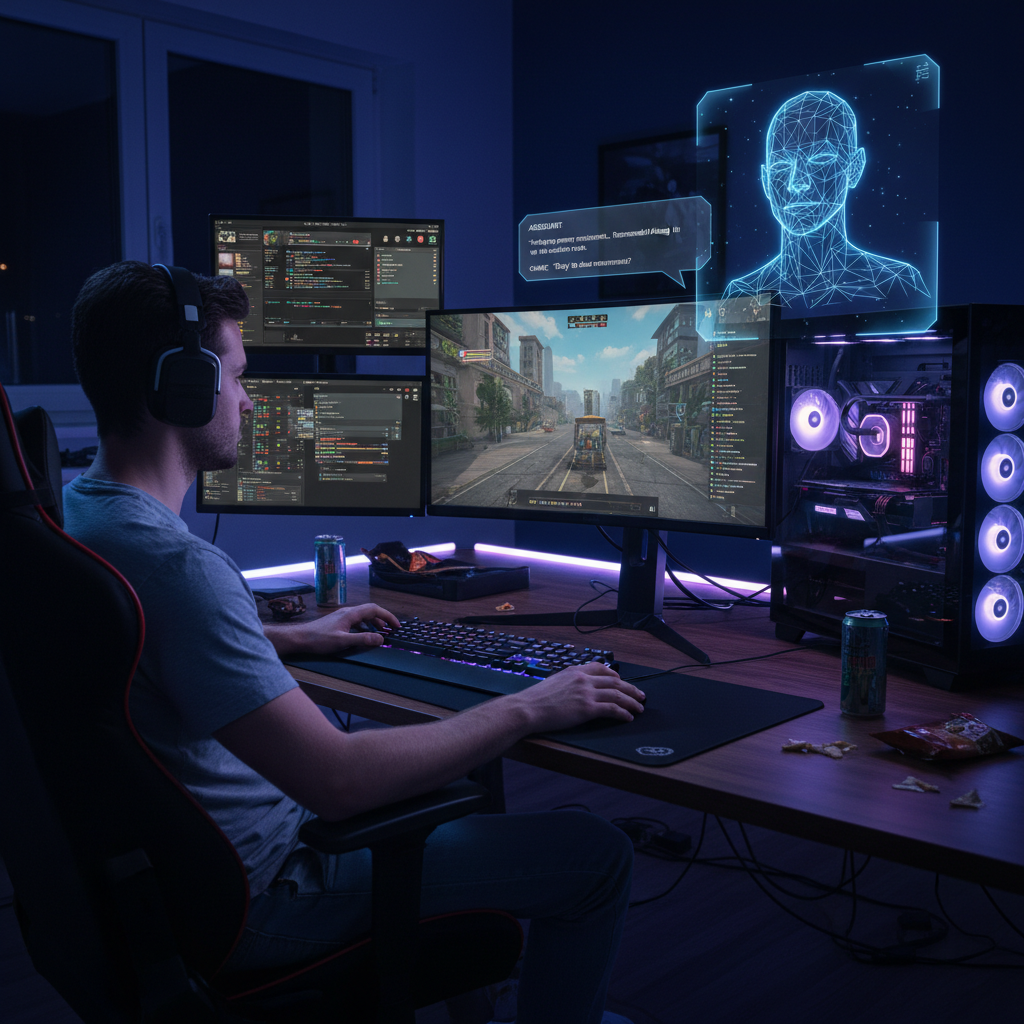
Nvidia has unveiled its experimental G-Assist AI tool, which users can run locally to optimize their PCs and improve gaming performance, while most currently use their GeForce RTX cards for immersive gaming. The Nvidia desktop application offers a floating overlay feature that enables users to interact with an AI assistant through text or voice commands to monitor system stats and adjust settings.
G-Assist offers a range of intriguing capabilities. Users have the ability to submit broad questions like “What is the mechanism behind DLSS Frame Generation?”. “, and receive informative responses.
The AI has the ability to modify particular system-level configurations. Gamers who call on G-Assist receive live system performance reports that include real-time generated data visuals. The AI system allows users to adjust settings for individual games or modify system features through command operations. G-Assist provides GPU overclocking options for adventurous users along with projections of expected performance improvements.
The public release demonstrates potential but lacks the advanced integration shown in demonstrations from the previous year. G-Assist originally aimed to deliver context-sensitive guidance during gameplay to help players reach their objectives. The level of integration currently exists for only a limited number of titles, with Ark: Survival Evolved being a prominent example.
Nvidia has enabled expanded functionality by supporting third-party plug-ins. G-Assist has compatibility with devices from leading manufacturers including Logitech G, Corsair, MSI, and Nanoleaf. The functionality enables creative applications like directing MSI motherboards to modify their thermal settings or commanding Logitech G devices to change LED lighting according to system status or gameplay events.
With more “AI laptops” entering the PC market, Nvidia aims to show that desktops with dedicated GPUs possess built-in AI power. Nvidia released the general-purpose ChatRTX app when most AI tools were cloud-based. G-Assist targets gamers who already use high-performance GPU hardware in their systems.
Nvidia states that operation of G-Assist depends on a small language model (SLM) which has been carefully optimized for local execution. A basic text installation needs 3GB, but voice control requires an extra 3.5GB, which results in a total storage requirement of 6.5 GB. G-Assist requires an NVIDIA GeForce RTX 30, 40, or 50 series GPU with at least 12GB of VRAM in order to work properly. The operation speed of G-Assist increases with GPU power, which allows cards with greater capabilities to run G-Assist more quickly. Future updates will enable support for laptop GPUs, but their present performance constraints may diminish G-Assist’s efficiency.
Choosing to operate G-Assist on local GPU presents immediate challenges despite providing long-term benefits in privacy and reduced latency. GPU utilization showed a significant increase when we tested interactions with the AI model using an RTX 4070.
Generating responses through inference computing has an impact on concurrent activities, especially gaming performance. The frame rates of Baldur’s Gate 3 at maximum settings suffered approximately a 20% reduction when running G-Assist processing.
Systems that already find it difficult to sustain smooth gameplay might face increased performance problems with G-Assist. G-Assist achieves faster performance in applications other than resource-heavy games, yet requires a powerful GPU for sustained use.
G-Assist still shows experimental characteristics through its sporadic performance delays and software glitches. The majority of users find that direct manual configuration of system and game settings proves to deliver better efficiency.
G-Assist functions as an innovative advancement in utilizing the untapped AI processing capabilities of gaming PCs. The ongoing development of GPU technology makes it more feasible to run intensive games alongside complex AI systems at the same time.
Nvidia’s G-Assist currently provides an interesting yet flawed preview of what AI-integrated gaming could look like in the future. This experiment illustrates a potential future where GPUs not only generate virtual environments but also help players navigate them.