
- calendar_today October 20, 2026
Buffalo Apartment Building Hosts Landmark Battery Storage Project
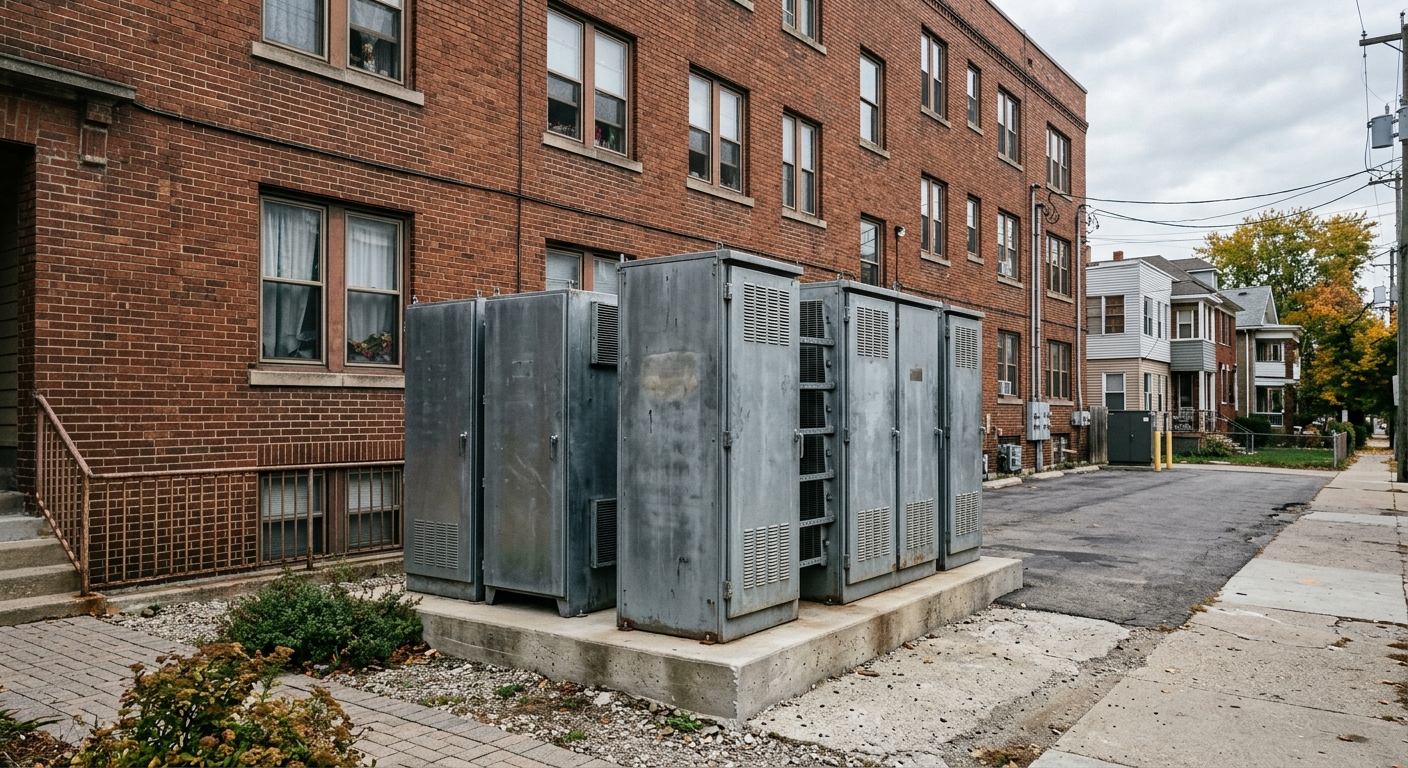
A Buffalo, New York, apartment complex is at the center of a pioneering effort to demonstrate that large batteries can safely power residential buildings. The Peace Bridge Place affordable housing complex now contains a 3.75 megawatt-hour lithium-ion battery system, one of the largest installed in a U.S. residential building according to manufacturer Viridi and developer Good Carbon Co.
Supporting Energy Resilience and Cost Savings
The battery storage system at Peace Bridge Place will capture surplus energy when available and deliver power back to the building when the grid faces high demand or electricity prices spike. According to Viridi CEO Jon M. Williams, distributed battery storage can make electric power more resilient, affordable, and available. The system is designed to operate for several days, providing backup during outages and helping the building reduce its reliance on the grid during peak times.
The apartment complex will also be compensated by the utility for not drawing power from the grid when demand is high and for returning electricity to the system—measures that can lower residents’ overall energy costs.
Addressing Safety and Fire Prevention in Battery Storage
Safety remains a significant concern for deploying lithium ion batteries at scale in residential areas, given past incidents involving battery fires. Williams noted that previous products entering the market in the last decade have, in some instances, led to fires. Viridi spent six years and $10 million developing a fireproof container, including extensive testing to ensure failure in one battery cell would not spread. Their patented design uses plates, pouches, and spacing to isolate each cell, preventing gas, smoke, heat, or fire from escaping the container.
The Peace Bridge Place battery system had to pass a rigorous safety test: a battery was deliberately failed while enveloped in cheesecloth. The cheesecloth showed no signs of burning or charring, satisfying stringent Underwriters Laboratories safety requirements. This allowed the system to be certified for indoor installation without additional fire suppression measures.
Contributions to Renewable Energy and Grid Reliability
Deployments like this are considered essential for transitioning from fossil fuels to renewable energy sources. Batteries can provide a steady flow of power when solar or wind energy is unavailable and can store excess hydroelectricity—important in New York, one of the country’s top hydropower-producing states. Buffalo, near Niagara Falls, benefits directly from this proximity.
State and industry experts see large battery systems as crucial for maintaining grid reliability and controlling costs as energy demand grows. Jigar Shah, a clean energy finance expert, called the Peace Bridge Place installation a milestone and predicted significant growth in home battery use by 2030.
Focus on Affordable Housing and the Clean Energy Transition
The Peace Bridge Place project received support from the New York State Energy Research and Development Agency (NYSERDA), which is working to include disadvantaged communities in the clean energy transition. The building, entirely electric and heated and cooled via geothermal system, was selected for its high energy needs and lack of natural gas reliance. National Grid, the utility, also backed the initiative. Good Carbon Co. noted that such energy storage systems will play an increasingly important role in future multifamily housing projects.
Peace Bridge Place is classified as affordable housing, with renters earning no more than 80% of the area’s median income. The energy savings generated by the battery system can help keep costs lower for residents.
Industry Impact and Future Outlook
Viridi’s manufacturing sites in Buffalo and Richmond, California, can produce enough battery packs annually to power about 14,000 average U.S. homes for 24 hours. The company’s systems are already being used in a Buffalo medical research building, and California is rapidly expanding its own battery storage infrastructure, with 2,000 new systems coming online each week and the world’s largest battery project under construction in Fresno County.
Experts like California Energy Commission Chair David Hochschild believe the battery industry will play a critical role in the clean energy transition for decades. While challenges around cost and safety remain, projects like Peace Bridge Place highlight ongoing progress in battery fire prevention and energy resilience.
Source: abcnews.com.