
- calendar_today August 20, 2025
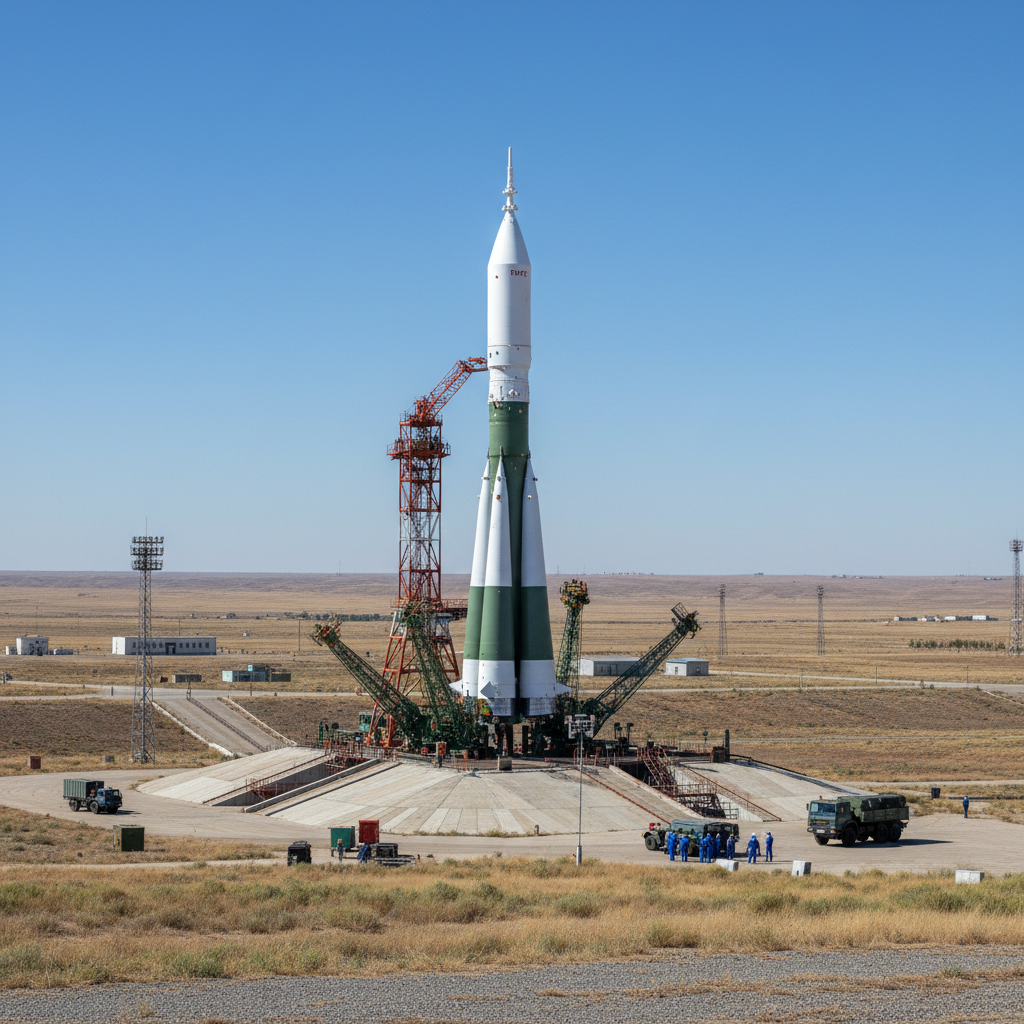
Russia’s new Soyuz-5 rocket could fly before the end of the year. That is the goal that Dmitry Bakanov, the director of the Russian state space corporation Roscosmos, gave in an interview with the Russian state-run news agency TASS. “Yes, we are planning for December,” he said. “Everything is in place.”
Launch preparations for the rocket’s inaugural flight from Baikonur cosmodrome in Kazakhstan are apparently on schedule.
The Soyuz-5 has been in development for over ten years. But if the rocket launches this year, it will fly only on its maiden test flight. Roscosmos does not expect the rocket to enter service until 2028.
So far, the Soyuz-5’s most important role has been as a stepping-stone in the transition from old Soviet rockets like Proton-M and Zenit, which Russia has relied on for launches since the 1980s.
A well-established Rocket design With Soviet Origins
The Soyuz-5 rocket was known as the Irtysh, a large river that runs through western Russia and central Kazakhstan, before the program was absorbed by Roscosmos.
The rocket’s design itself is not particularly new. In fact, the Soyuz-5 is essentially a modernized version of the Zenit-2 rocket, which the Ukrainian Yuzhnoye Design Bureau began developing in the 1980s. Yuzhmash in Dnipro, Ukraine, built and operated several Zenit rockets from the late Soviet era until the 2010s.
The Zenit-2, powered by the highly powerful RD-171 engine built by Russian NPO Energomash, was developed before RD-170 engines to produce more thrust of any liquid-fueled engines, although other modifications were made.
Zenit launch vehicles have production facilities in both Ukraine and Russia. Russia and Ukraine have effectively split Zenit production between the two countries after the Soviet Union’s collapse. Russia continued to supply rocket engines and boosters to Ukraine for years. The uneasy alliance has now reached an end following Russia’s full-scale invasion of Ukraine in February 2022.
Russia launched an attack on the abandoned Zenit rocket manufacturing facility using a ballistic missile in late 2023, the most recent in a series of assaults on the site, a demonstration of Moscow’s disinterest in renewing the collaboration.
Roscosmos, on the other hand, has advanced with Soyuz-5, a rocket designed to be domestically produced with no Ukrainian components and supplant Zenit rockets in production.
Highlights of Soyuz-5
With little change from Zenit-2 design, Soyuz-5 booster’s main propellant tanks are just somewhat bigger, providing the rocket with a lift capability of around 17 metric tonnes to low-Earth orbit (LEO).
A vehicle with a similar lift capacity, SpaceX’s Falcon 9, for example, is categorized as a medium-lift launch vehicle. In contrast to Falcon 9, though, Soyuz-5 is entirely expendable; all of its components are destroyed during a launch.
Soyuz-5’s RD-171MV engine is the most recognizable feature. It is a more recent generation of Energomash’s creation that also powers Russia’s Energia rocket and Zenit series.
The Soviet-era design has since been updated to remove all Ukrainian parts and ensure Russian self-sufficiency.
It generates more than three times the thrust of a NASA Space Shuttle main engine and consumes kerosene and liquid oxygen as fuel.
As a result, the RD-171MV is the most powerful liquid-fueled rocket engine in the world.
At this time, Soyuz-5 is a symbol of perseverance, not breakthrough innovation. This is because, in its current form, Soyuz-5 is a Zenit update rather than a next-generation rocket.
Soyuz-5: The Transition to Russia’s Newest Rockets
Soyuz-5, on the other hand, is far more than a Zenit replacement for Russia. By removing Ukrainian components and phasing out the Proton-M launch vehicle, Roscosmos will keep a medium-lift capability while also becoming independent of Ukrainian parts.
At the same time, however, Roscosmos does not anticipate Soyuz-5 being Russia’s long-term medium-lift rocket.
That, on the other hand, is the job of a “truly next-generation” vehicle, most likely to be called Soyuz-7 but referred to by some as Amur. The vehicle, which will include a reusable first stage powered by liquid oxygen and methane engines, has been postponed several times.
Angara family of rockets, which now include Soyuz 5, Soyuz 6, and Soyuz 7, are the country’s next-generation rockets.
As a result, Roscosmos must keep the space flight solution going as long as they are able.
It was anticipated to fly in 2024, but by 2026 at the earliest, some reports say. This rocket, dubbed Amur, is now anticipated to make its debut in 2030 at the earliest.
Until the Soyuz-7 is operational, it appears that Roscosmos will rely on Soyuz-5 rockets as an intermediary solution: a reliable, if not original, rocket that would enable Russia to keep its launch business operating in the face of sanctions, a shrinking budget, and political isolation.
Commercial Opportunities Unclear
Russia’s Soyuz-5 rocket’s commercial appeal is one of Roscosmos’s largest challenges. SpaceX has pushed the launch market to a new low for cost and reusability over the last ten years. Against this backdrop, an old Soviet-era design rocket that is also expendable might not perform very well.
Roscosmos continues to operate its Soyuz-2 rocket, which is still used for crewed flights, as well as the newer Angara family, which is designed for heavier payloads and can also launch lighter satellites, but both face an uphill climb to catch up on lost market share and profitability.
The question is whether the Soyuz-5 can be the exception to this rule.
Nonetheless, just getting the Soyuz-5 to the launch pad in the face of the economic pressures of a wartime is an impressive achievement for Roscosmos. A test flight at the end of this month would be evidence that the country’s space industry, while under duress, can still put new rockets on the launch pad.
In Conclusion
The Soyuz-5 is not a state-of-the-art rocket, but for Russia, it is a rocket with the symbolism. With a domestically made rocket, Roscosmos intends to take over as a successor to the Zenit and Proton-M, two of its mainstay launch vehicles, and hopes to solidify its position in spaceflight in the face of a continuing economic and political quarantine.
For all of its capabilities, the question is whether Soyuz-5 would eventually be able to break into the new markets or whether Roscosmos is just betting on the unlikelihood that new rockets would not fly and blocking them from reaching Russia’s payload deployment customers.
For now, though, the country’s spaceflight community will be eagerly anticipating the December test flight of Soyuz-5 from Baikonur, as it is the rocket’s first time since the start of the war, a demonstration of the space agency’s ability to adapt and overcome in the face of new hurdles.