
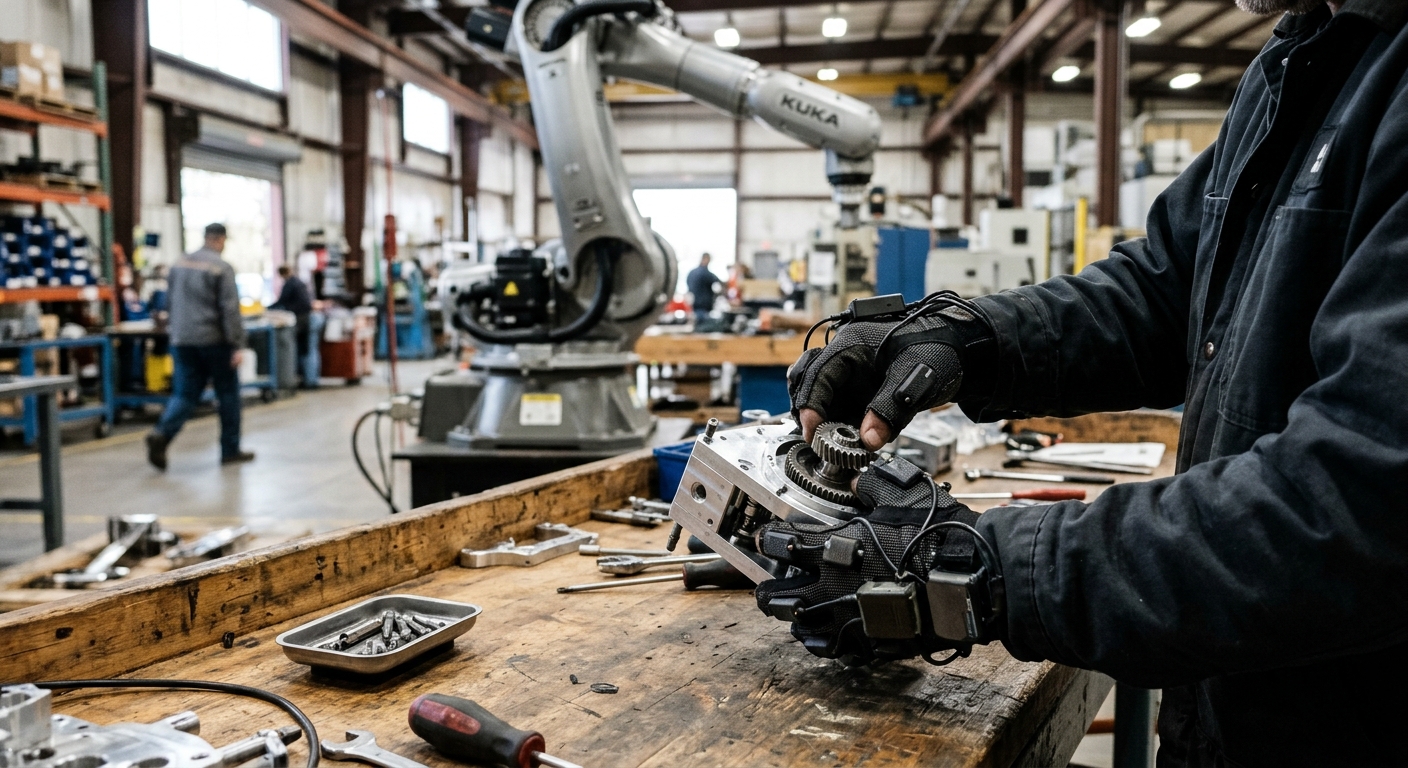
AI-generated illustration; not a photograph of the reported event.
- calendar_today November 21, 2026
Major Funding for Genesis AI's Robotic Workforce
Genesis AI, a robotics company developing general-purpose robots, has secured $500 million in Series A funding. This investment values Genesis at $3.5 billion and is backed by industry leaders such as Premji Invest, Khosla Ventures, Eclipse, NVIDIA, AMD Ventures, Samsung Next, and Zoom. Notable tech figures supporting the round include former Google CEO Eric Schmidt, Zoom CEO Eric Yuan, and Yahoo co-founder Jerry Yang. Accounts advised by T. Rowe Price and other financial firms also participated. The funding will accelerate the development, training, and deployment of Genesis AI's signature robot, Eno, aimed at transforming workplace productivity.
How the Eno Robot Learns Human Skills
The Eno robot is being developed to carry out complex tasks across a variety of industrial environments. Unlike many humanoid robots, Eno prioritizes functionality over human-like appearance. At its core is GENE, Genesis AI’s advanced artificial intelligence model, which equips Eno with the capability to interpret and respond to physical surroundings using dexterous, human-like robotic hands.
Robot Training with Electronic Gloves and Cameras
Genesis AI has designed a unique training process where workers wear electronic gloves during their regular routines. These gloves capture detailed finger movements and the amount of pressure applied, creating a one-to-one mapping to the robot's hands. Workers also wear cameras on their heads to record tasks from their perspective. This combination of data is used to train the robotic brain, GENE, allowing the robot to acquire complex physical skills without pre-programmed movements.
Simulated Practice for Faster Robot Training
Genesis AI employs 'Genesis World', a simulation platform that recreates physical environments for robots to practice acquired tasks. For example, robots can learn to play the piano by emulating a person’s movements, then repeatedly refine those skills in virtual settings. This allows for rapid improvement without the cost or logistical challenges of constant real-world training.
Current Capabilities and Demonstrations
To date, Genesis AI has demonstrated its robotic brain’s abilities in tasks such as meal preparation, laboratory operations, wire harness assembly, packaging, and even solving a Rubik’s Cube. These have mostly been carried out on test robots, with plans to transfer capabilities to Eno as development progresses. Investors point to promising demonstrations, such as robots autonomously completing multi-step tasks with smooth, natural motion, matching human speed and accuracy in controlled environments.
Deployment Plans and Industry Partnerships
Genesis AI began proof-of-concept projects and pilots with customers in 2026, gathering insights for commercial deployment scheduled for 2027. The initial focus will be on manufacturing, logistics, and laboratory settings. A strategic partnership with LG CNS, LG's AI transformation business, seeks to integrate Genesis robots into LG’s U.S. manufacturing and logistics operations.
Future plans include expanding to industries such as hospitality and healthcare, with potential for home and outdoor applications down the line. However, Genesis has not confirmed timelines for non-industrial deployments.
Workforce Implications and Ongoing Challenges
The process of training robots with human input naturally raises questions about job displacement. Genesis AI states that employee participation in data collection is voluntary, with clear consent and no personally identifying information collected. The company retains ownership of all training data.
Despite successes in controlled settings, the company faces challenges in proving long-term reliability and safety for Eno in variable, real-world industrial environments. Genesis has yet to release detailed commercial pricing or external reliability results. The eventual impact on workforce composition and job roles remains uncertain, and broader conversations about technology and employment are ongoing.
Looking Ahead
While Eno robots are not expected to be commonplace in the immediate future, Genesis AI’s technology offers a glimpse of how physical jobs could change over the next few years. These workplace robots may reduce repetitive manual labor and alter the skills demanded of workers. The company emphasizes collaboration, but as technology advances, questions about automation and employment will persist.
Source: foxnews.com.