
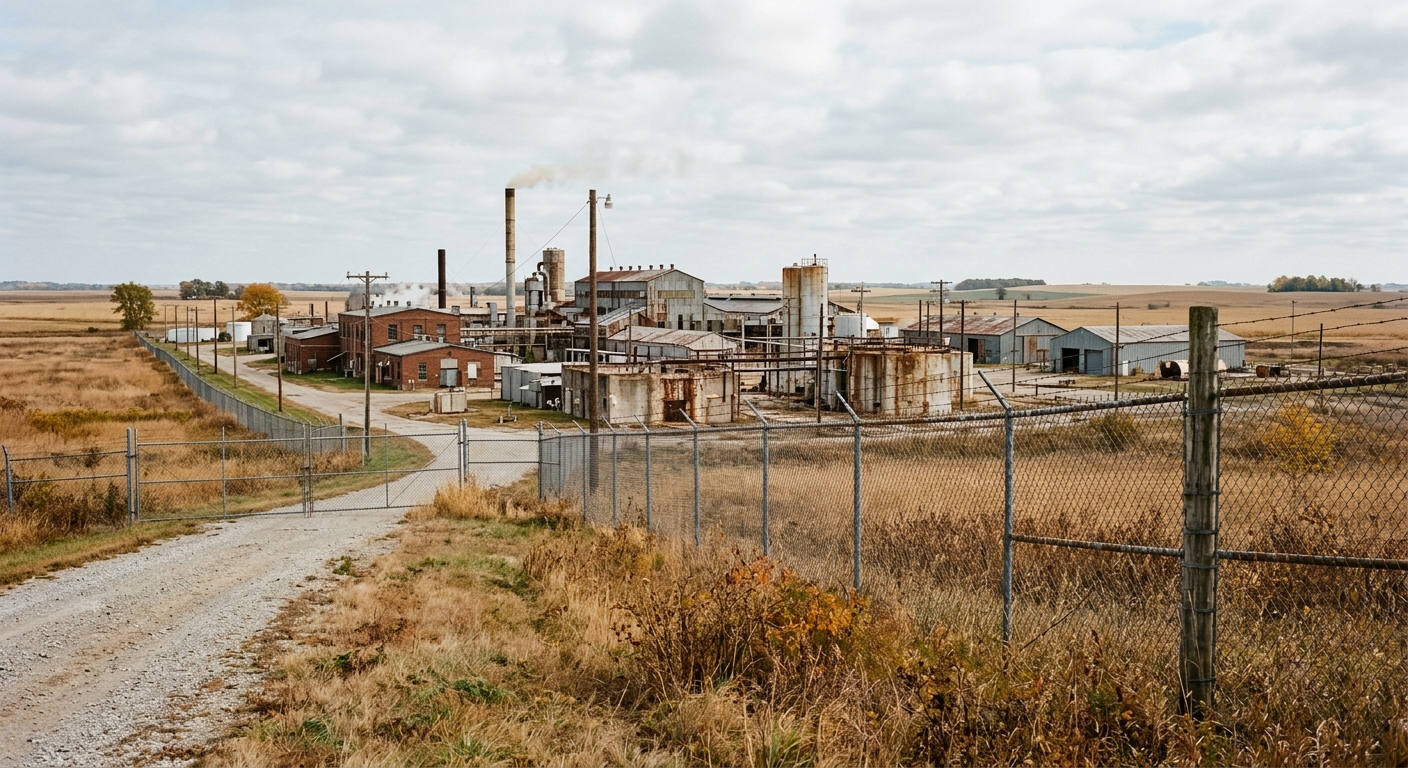
AI-generated illustration; not a photograph of the reported event.
- calendar_today November 24, 2026
Unstable Explosives Scheduled for Detonation
The U.S. Army will detonate approximately five tons of explosives containing lead azide at the Iowa Army Ammunition Plant in Middletown on Wednesday morning. This operation follows a series of legal challenges, environmental concerns, and emergency preparations involving federal and state officials.
Timing and Details of the Planned Explosion
The detonation is scheduled for 9 a.m. Central time, according to acting Secretary of the Army Adam Telle, who spoke at a press conference on Tuesday. Telle emphasized that the Army has put in place "unprecedented, innovative solutions" to reduce potential dangers associated with the blast, including the spread of a toxic plume that could affect the wider region.
Telle explained, "The substance becomes much more dangerous as temperatures stay low for prolonged periods." Weather patterns forecasted for Wednesday were cited as ideal for minimizing public health risks.
Court Rulings and Political Involvement
The 8th Circuit Court of Appeals ruled on Monday not to block the Army from proceeding with the planned detonation. This decision followed urgent warnings from environmental groups, who argued that a blast could launch a plume of lead particles into neighboring communities and that adequate risk assessments and public notice had not been provided by the Environmental Protection Agency (EPA).
The court found that the degraded explosives presented an immediate threat of an uncontrolled explosion, concluding that a controlled, mitigated detonation was preferable. The ruling also noted that safeguards were in place, and that relevant agencies had considered alternatives for dealing with the explosives, which have been stored at the site for decades.
Local and Federal Leaders Respond
Iowa Governor Kim Reynolds expressed support for the Army's plan. President Trump earlier signaled that the detonation would only go ahead if the courts and incoming Democratic Iowa Governor-elect Rob Sand approved, adding that expert consensus was in favor of the detonation as the best available option. Sand, however, called for greater transparency about why this strategy was chosen and how the site reached its current state.
Multiple federal agencies participated in reviewing the plan, including the Army, Navy, EPA, ATF, FBI, DARPA, Department of Energy, CDC, HHS, and FEMA.
Environmental and Public Health Concerns
Environmental groups, including the Sierra Club and the Iowa Environmental Council, raised significant alarms about potential lead contamination from the detonation, suggesting that lead dust could spread for up to 100 miles. They argued that insufficient time was provided for local residents to prepare, and that the EPA had not fully evaluated all environmental and health risks or considered alternatives.
An earlier plan had asked some Middletown residents to evacuate for six hours and warned of loud noises, vibrations, and a visible dust plume. Iowa and Illinois lawmakers from both parties voiced criticism of the plan and pressed federal agencies to seek other solutions.
Background and Ongoing Risks
The Army has stored the lead azide in earth-covered containers for decades at the Middletown facility, located in southeastern Iowa near the Mississippi River. The EPA said the explosives deteriorated over time, creating a risk of explosion if disturbed. According to the Army, immediate action was needed before falling temperatures increased the chances of a spontaneous and uncontrolled detonation.
As the operation moves forward under court approval and government oversight, monitoring for environmental impact and public health remains a focus for both authorities and concerned citizens.
Related coverage
Source: cbsnews.com.