
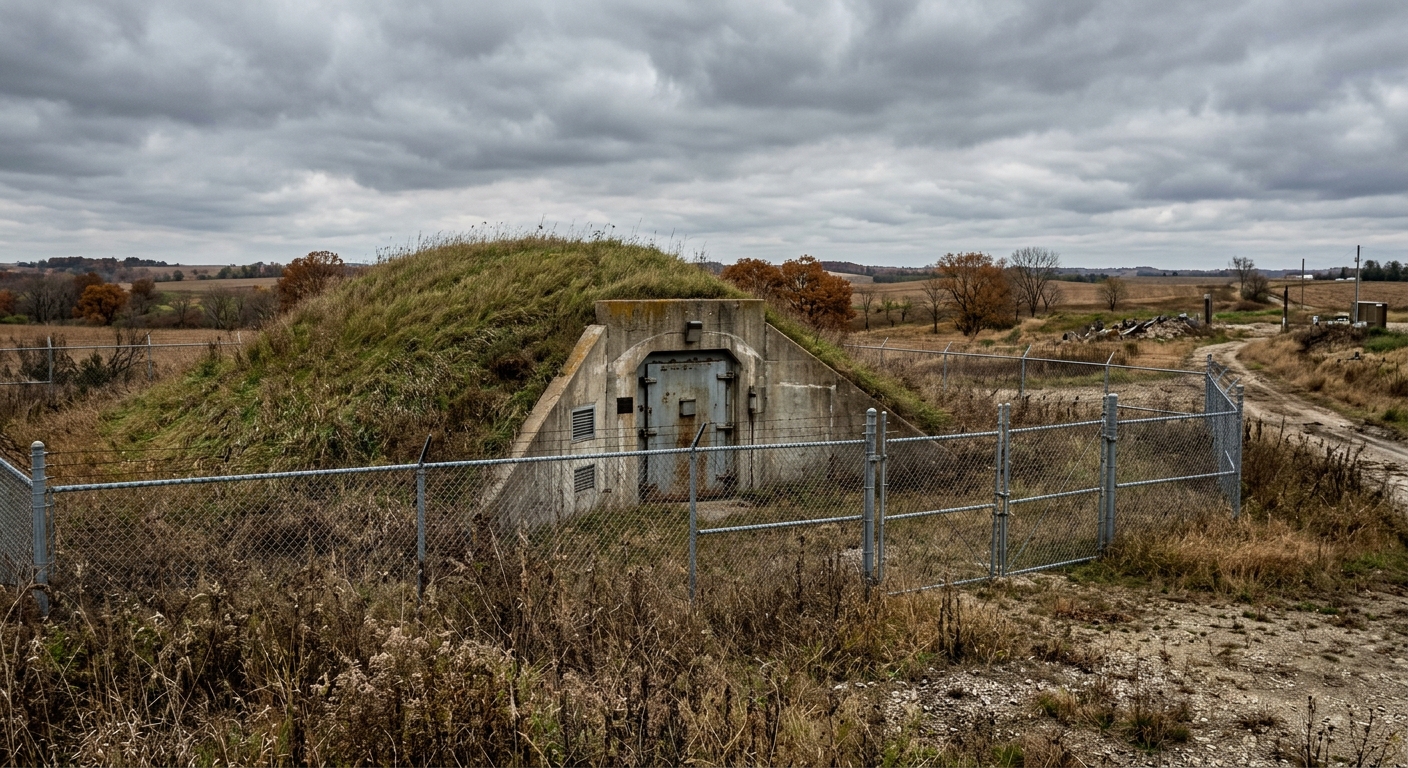
AI-generated illustration; not a photograph of the reported event.
- calendar_today November 21, 2026
Army’s Plan to Detonate Unstable Explosives Halted by Court
A federal court has indefinitely suspended the U.S. Army’s plan to detonate several tons of lead azide, a highly unstable explosive, at Iowa’s Army Ammunition Plant in Middletown following widespread concerns from residents and environmental groups about potential toxic risks.
Background: The Discovery of Unstable Explosives
In March, the Army reported discovering 68 drums of lead azide at the Iowa Army Ammunition Plant undergoing “recrystallization”—a process that significantly increases the instability and risk of spontaneous explosion. Lead azide, stored in bunkers since production at the plant began in 1941, is extremely sensitive to triggers including sparks, friction, and even slight physical pressure, according to military and EPA sources.
Why a Controlled Explosion Was Chosen
Army officials stated that cold weather could further destabilize the already hazardous material, making it unsafe for relocation. After reviewing four possible disposal methods, the Army determined a controlled explosion posed the lowest risk to the immediate and surrounding areas. Adam Telle, Acting Secretary of the Army, explained this conclusion came after months of planning with the Department of Health and Human Services and the Environmental Protection Agency to ensure maximum safety and mitigation of public risk.
Community Outcry and Legal Intervention
The scheduled detonation, originally set for noon on a Friday, was postponed until Monday before the 8th U.S. Circuit Court of Appeals granted an emergency motion to suspend it. Environmental groups filed suit, citing the possibility of toxic lead dust spreading across Iowa and Illinois. While Army officials said they had communicated with local stakeholders, many Middletown residents reported learning of the plan only days before the scheduled event.
Iowa Gov.-elect Rob Sand criticized the lack of communication, calling for the federal government to prioritize residents’ safety. Local concerns were heightened by fears the explosion’s dust plume might release dangerous lead particles, which can cause serious health problems, especially for young children.
Public Health and Environmental Risks
Lead exposure is particularly harmful to children under six, affecting growth, learning abilities, and neurological development. David Cwiertny, a University of Iowa professor and Environmental Policy Research Program director, explained that lead dust generated by the explosion could travel through the air and settle on the ground, potentially contaminating food, water, and local environments for years to come.
Residents were advised to evacuate the area during the detonation, but fears remained about long-term environmental and groundwater contamination. Middletown resident Sean Byers voiced concerns over potential lingering contamination and the proximity of local playgrounds to the ammunition plant.
Army’s Mitigation and Safety Measures
To reduce risks, the Army proposed detonating the lead azide within reinforced, earth-covered magazines surrounded by large sand-filled Hesco barriers, and saturating soil and air with water to limit dust. Despite these efforts, notifications warned residents about possible window damage and suggested that repairs would be handled by the plant. However, skepticism remains regarding decontamination efforts for homes potentially exposed to lead dust.
The Army maintains that post-detonation lead levels will remain below EPA thresholds that require protective action, owing to their mitigation steps. The situation remains suspended while the legal process and community discussions continue.
Related coverage
Source: cbsnews.com.