
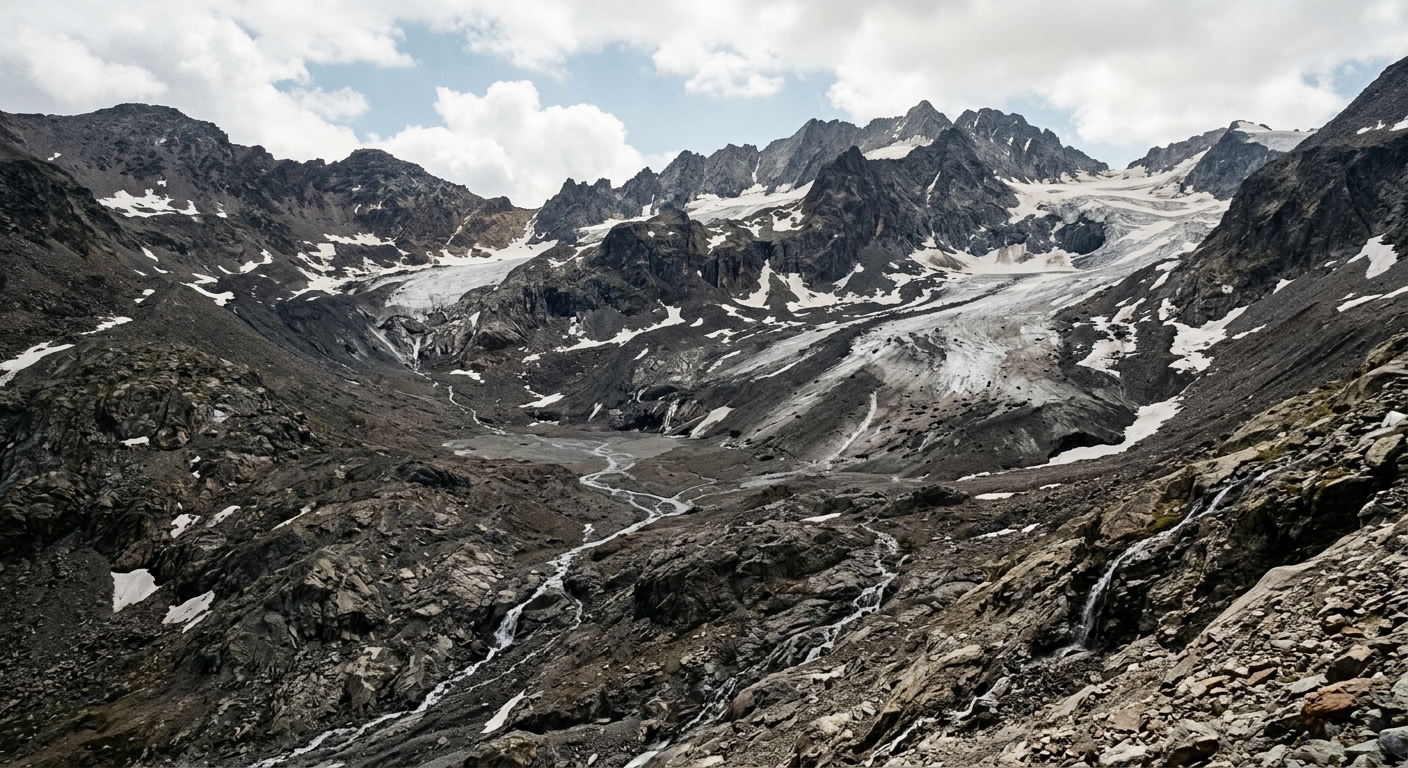
AI-generated illustration; not a photograph of the reported event.
- calendar_today October 27, 2026
Record Low Snowpack and Heat Lead to Dramatic Glacier Thinning
Colorado's most significant glaciers experienced a dramatic thinning in 2026, according to new research. The decline has been attributed to a combination of record low mountain snow and record warm temperatures, conditions that left year-round ice masses in the Rocky Mountains exposed to accelerated melting and loss.
Accelerated Glacier Thinning in Colorado's Rocky Mountains
Glaciologist Dan McGrath from Colorado State University analyzed changes specific to the year 2026, an exceptional period marked by the state’s lowest snowpack on record followed by an extremely hot summer. The findings reveal that Andrews Glacier thinned by over 12 feet (3.7 meters) within the year, Arapaho Glacier lost nearly 10 feet (3 meters), and Isabelle Glacier thinned by about 6.5 feet (2 meters). These rates doubled their average thinning compared to the previous five years. In the preceding decade, annual thinning was typically a foot or less.
Additionally, St. Mary's Glacier, a perennial snowfield favored by hikers and skiers, melted away entirely in September 2026.
Broader Patterns of Glacier Loss
The trend observed in Colorado mirrors glacier shrinkage seen across the globe. Warmer temperatures and decreased snowfall are accelerating glacier thinning everywhere, threatening water sources, increasing hazards in mountainous areas, and contributing to rising sea levels. "What we’re witnessing is the loss of that part of Colorado’s identity," said McGrath, noting similar patterns in the western United States, the European Alps, and other mountain ranges worldwide.
Since 2000, over 7 trillion tons (6.5 trillion metric tons) of ice has been lost globally, a gradual but significant contributor to sudden disasters. For example, in August, more than 1,300 people died after a massive section of rock and glacier collapsed near Nepal’s border with China.
Trends in Other Regions: United States and Beyond
Elsewhere, the effects of record heat and low snowfall are similarly pronounced. Switzerland’s glaciers lost 5.5% of their volume in 2026, the second-biggest percentage drop on record, according to the Swiss glacier monitoring service GLAMOS and the Swiss Academy of Sciences. In Washington state, researchers reported the fastest average retreat since 1950 for glaciers on Mount Baker, including the collapse of large ice caves due to warm air circulation.
A recent study co-authored by Brian Menounos, an earth sciences professor at the University of Northern British Columbia, found that since the mid-1900s, one-quarter of the mountain glaciers in the contiguous United States have disappeared, with remaining glaciers losing about a third of their area and volume. Glacial runoff supplies water to both high alpine and downstream ecosystems in the West, and their continued retreat increases drought vulnerability as glacier-fed water sources diminish.
Factors Accelerating Glacier Melt and Long-Term Outlook
Wildfires are also expediting glacier melt, as soot and dust darken glaciers, making them more absorbent to sunlight. Menounos noted that although glaciers might re-form in the future if carbon emissions decline significantly and cooler temperatures return, the process could take hundreds of years.
McGrath warns that looking at the amount of ice lost from Colorado’s remaining glaciers, they may soon vanish. Andrews Glacier has already shed half its ice since 2017. “This past decade has showed us that these glaciers are out of balance with the climate here in Colorado, in the western U.S., and they’re thinning at a rate that could lead to their demise in the next 20 years,” he said.
Documenting Glacier Disappearance
Harlan Ulmer, a 20-year-old student at Colorado State University, has been photographing the glaciers annually since 2022 and volunteers on McGrath’s research project. Ulmer finds it important to document the changes occurring now for the sake of posterity and future generations, stating, “Being Gen Z, I came in too late to ever see the glaciers at their largest, but I think we have the opportunity, I have the opportunity, to sort of document the changes that are taking place in my time.”
Source: abcnews.com.